
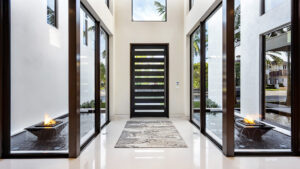
Arthur Griffing ran a nursery before he ever sold a house lot, and a century later you can still tell. Biscayne Park’s planted medians, its cul-de-sacs and its shade trees came from a man who thought like a gardener. The village is small, quiet and a designated bird sanctuary, and many of its homes have been here long enough to have real character. That’s what shapes how we approach glass door inserts in Biscayne Park: the glass should look like it belongs to the house, not like it was picked from a big-box aisle.
An insert is a complete glass panel with its own frame, fitted into your existing door. We install it in one visit, usually an hour or two, and you keep your door. There’s no trim to pull off and nothing to repaint. If you’d like to talk through your house first, call us at (352) 862-4122.
Reading the age and style of your house before picking glass
Biscayne Park has a mix you don’t see in newer suburbs. Some houses go back to the original Griffing Biscayne Park Estates era, including Mission Revival homes with stucco walls and simple, sturdy lines. There are bungalow-style houses, too, and later homes that filled in lots over the decades. Each one calls for a slightly different kind of glass. Even the village hall, the hand-built Log Cabin on NE 114th Street, shows how much people here care about original materials.
A Mission-style house usually looks best with glass that feels hand-made: a gentle texture, small panes, maybe a dark metal line or two. A bungalow tends to suit a clean rectangle of glass, sometimes split by a simple grid. A later house can carry something plainer, such as clear glass with a slim bevel. The idea is to take your cues from the windows, the roofline and the hardware you already have, then choose door glass that agrees with them.
Glass types that look at home on an older facade
You don’t have to settle for shiny, busy patterns. Several glass types have a long history and look right on a house with some age to it.
Seeded glass has tiny bubbles in it, like old hand-blown glass. It softens the view without hiding daylight. Glue chip has a frosty, fern-like surface that was popular early in the last century. Rain and water textures give privacy with a gentle, uneven look. Clear beveled glass with a few simple lines reads as classic rather than modern.
Any of these can be the main field of the insert or an accent next to clearer panes. Mixing two textures, one for privacy low on the door and one for light up top, is a trick that works well on older entries. Browse the finished work in our photo gallery of door glass styles and note which textures catch your eye.
Glass door inserts in Biscayne Park that keep your original door
A lot of owners here love their doors. Maybe it’s a heavy door that’s been on the house for years, or one you had refinished after a long search for the right color. Replacing it would mean losing all of that. Door glass replacement lets you keep the door and change only the glass.
It also works in reverse. If your door has no glass at all and the foyer feels dim, we can often add glass to an existing front door so the entry gets daylight. We can install glass in most exterior doors, and the free estimate is where we confirm yours. Either way, your door’s paint or stain stays as it is.
Metal finishes that look settled, not shiny
The thin metal strips between pieces of decorative glass are called caming. On an older house, the finish of that metal does as much for the look as the glass does. Bright brass can feel too new on a stucco Mission facade. Darker finishes, such as oil-rubbed bronze, black or patina, tend to blend in and look settled from day one.
Match the caming to what’s already on the door if you can: the knob, the deadbolt, the hinges and the house numbers. When those agree, the new glass looks like part of the original design instead of an add-on.
Shade trees, dim foyers and afternoon light
Griffing’s trees are one of the best things about living here, but they also make some entries dark. A leafy yard and a deep porch can leave a solid door as the only thing between you and the daylight. A textured insert fixes that without giving up privacy on the street.
Not every door is in the shade, though. If yours faces west and takes the late sun, Low-E glass is worth a look. It has a thin coating that cuts the heat that comes through the glass, which matters far more in our climate than keeping warmth in. We’ll check which way your door faces when we visit.
Hurricane season for a house with some history
Miami-Dade has the strictest hurricane standards in the country. Impact glass door inserts are available, and they can be made in several of the traditional textures. Keep in mind that an impact rating belongs to the whole tested assembly (the glass, its frame and the door slab together), so an insert alone won’t make an older door hurricane-rated.
If storm protection is high on your list, tell us at the estimate. We’ll look at your door and give you a clear answer on which rated options fit it. For insurance, ask your agent directly. The opening-protection credit generally looks at every opening in the house and depends on the carrier.
Side, garage and pool doors deserve matching glass
Older homes often have a side door by the kitchen or a service door into the garage that nobody has touched in years. Carrying the same texture or caming finish to those doors ties the whole house together. We can do them on the same visit as the front door. If you have a pool, the cabana and pool-bath doors are good candidates too, since frosted glass gives privacy and light at the same time.
Garage door glass inserts are another quiet upgrade. A row of textured panes along the top lets light into the garage and gives a plain door a bit of detail. Our step-by-step install overview shows how the work goes, and it’s the same whether we’re fitting one door or several.
Nearby villages and towns we serve
Biscayne Park sits between two neighbors we know well. Just south, across NE 107th Street, we serve Miami Shores, and to the north we install glass door inserts in North Miami. Out on the bay, we work with condo and home owners in North Bay Village, and on the beach side we cover Bay Harbor Islands and Bal Harbour. The full list is on our map of the South Florida areas we serve.
Older-home questions from Biscayne Park
My house is one of the village’s older ones. What door glass would look original to it?
Look at the windows and trim first. Early Mission-style homes usually suit textured or seeded glass with a few darker metal lines, while bungalows tend to look best with a simple rectangle or grid. We’ll bring samples to your door so you can judge them against the real house.
Can new glass look vintage instead of shiny and new?
Yes. Seeded, glue chip and rain textures all have an older, hand-made feel, and a dark caming finish like oil-rubbed bronze or patina helps them look settled right away. Many owners pair one of these with clear beveled accents.
My street is shaded by big trees near the medians. Do I still need Low-E glass?
Maybe not on a fully shaded door. Low-E is most useful on doors that face west or south and take direct sun. We’ll look at how your entry is exposed before recommending it.
Will you have to strip or refinish my door?
No. We swap only the glass and its frame, the trim stays put, and the paint or stain is left alone. We also leave the area around your door as tidy as we found it.
What’s the best way to get started on an older home?
Send a couple of photos of your entry, or call (352) 862-4122, and set up a free estimate. We’ll measure, talk through styles that fit the age of the house, and give you a clear quote.
Glass that suits an older home
The houses in this village were built to last and to look good doing it. Well-chosen glass door inserts in Biscayne Park respect that and let more light into the entry. Book a free estimate by calling (352) 862-4122 or fill out our short quote request, and we’ll bring samples that suit your house.