
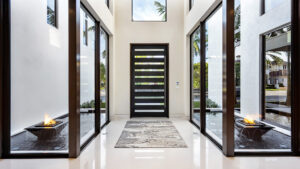
Glass door inserts in Boca Raton are a design decision before they are anything else. You’re choosing what the front of your house says to everyone who pulls into the driveway. We build decorative glass to fit the door you already own, set it in place with that door still hanging, and leave your frame, your paint, your hardware and your keys exactly as they were.
Boca pays attention to how a house presents itself. Hedges get shaped, driveways get washed, coach lights get swapped the moment they look tired. The front door usually gets left out of all that, mostly because people assume fixing it means buying a new one.
Start with the look you want. We’ll work backward from there and tell you honestly what your door can carry. Call (352) 862-4122 when you want to talk it through.
Deciding What You Want Your Entry to Say
Pick the feeling first and the pattern second. Almost every homeowner we sit down with wants one of three things at the front door: something formal and traditional, something light and coastal, or something clean and current with very little ornament. Naming that out loud takes about a minute and it cuts a catalog of hundreds down to a dozen.
Boca homes come in just about every style there is, so the answer changes house to house. Whether you’re in a newer community like Lotus, a classic ranch closer to Palmetto Park Road, or a country club villa out west, the glass that suits the house is the glass that agrees with what’s already around it.
Here’s a trick worth five minutes of your time. Stand at the end of your own driveway and take a photo of the front of the house on your phone, then look at the photo rather than the house. Your eye stops arguing with what you remember and starts seeing what’s actually there. Most people notice two things immediately: the door is darker and flatter than they thought, and the metal on the porch lights doesn’t match the metal on the handle.
Color belongs in the conversation too. A dark front door carries an ornate design without looking fussy, while a pale door lets every line in the glass show, so a busy pattern on a soft color can tip into noisy quickly. You don’t have to repaint anything. You just want the glass and the color pulling in the same direction.
That photo is also the single most useful thing you can send us. Text it over with a rough idea of the era the house belongs to and we can usually shortlist patterns before anybody drives out.
The Main Glass Families, Side by Side
Nearly everything sorts into five families. Once you know which family you’re in, choosing the exact design is the fun part rather than the hard part.
| Style family | What it looks like | How much you can see through | Suits |
|---|---|---|---|
| Beveled | Clear glass cut with faceted edges that catch afternoon light | A lot, it reads as clear | Deep covered entries and courtyard doors |
| Decorative with texture | Bevels set into softly textured fields | Shapes and shadows only | Most traditional Boca elevations |
| Frosted and privacy | Soft, even, no pattern to speak of | Nothing, and it still passes daylight | Doors near the sidewalk, cabana doors |
| Iron-look | Scrollwork sealed inside the glass | Depends on the fill behind the ironwork | Mediterranean arches and heavy doors |
| Reeded and rain | One quiet repeating texture, no ornament | Blurred outlines | Coastal contemporary and modern fronts |
Coastal and tropical designs deserve their own mention, because they get overlooked. Palm fronds, sea grass, waves and shells read as genuinely Florida rather than generic, and they suit the newer coastal-style homes closer to the water beautifully. On a formal country club elevation the same pattern can feel like a vacation rental, which is exactly the sort of thing worth catching before you order.
Have a look through the catalog with your family, put three favorites on a list, and call (352) 862-4122. We’ll tell you which of the three the house will actually thank you for.
Black, Bronze, Nickel or Brass
The metal framing around the glass changes how the same design reads from the street more than most people expect. Two houses can order an identical pattern, choose different finishes, and end up looking nothing alike from the curb.
- Black. The current favorite and the most forgiving. It sharpens a pattern and gets along with almost every wall color in Boca.
- Bronze. Warmer, quieter, and lovely under a barrel tile roof. The safe pick on a Mediterranean-style front.
- Satin nickel. Cool and understated. It suits newer construction and modern hardware.
- Brass. Traditional, and gorgeous when it’s fresh. Worth saying plainly: tired brass is a big part of why so many older entries look dated.
The rule we give everybody is to match the metal to your door handle and your porch lights. Not the roof, not the shutters, not the gutters. Those sit too far from the glass for anyone’s eye to connect them. If the handle is bronze and the coach lights are black, pick one of the two and let the glass follow it, or change the lights while you’re at it.
One more thing about finish. Salt air is hard on metal, and homes closer to the water go through hardware faster than homes out west. If you’re near the beach, tell us, and we’ll steer you toward finishes that hold up better in that air.
Half, Three Quarters or the Whole Door?
Quick word on the product itself, since the trade names cause confusion. What we build is a door lite, sometimes called doorglass: a finished decorative panel carried in a two-piece frame that grips your door through the opening from both faces. That’s why the door never leaves its hinges and why the frame around the door is never disturbed.
Inserts are described by how much of the door they cover, and that choice does as much design work as the pattern itself.
A half lite covers roughly the top half of the door and leaves the bottom solid. It’s the most private of the three and it keeps a heavy, grounded look, which is why it sits so well on traditional and Mediterranean fronts. A 3/4 lite starts just above the handle and carries most of the way up, which is the proportion you’ll see on the majority of Boca homes built from the nineties onward. A full lite runs nearly the whole height and turns the door into a glass panel, dramatic on a modern elevation and a lot of exposure on a suburban street.
There are narrow sizes for the side panels flanking your door and short wide ones for the transom over the top. Scale matters here. A design drawn for a wide door doesn’t simply shrink into a narrow panel, which is why companion patterns exist for the side glass.
If you’re torn between sizes, look at the doors on either side of you. Not to copy them, but because proportion on a street is usually consistent for a reason, and a door that breaks it tends to look odd rather than bold.
Three Boca Entries, and Where We’d Steer Them
Design advice gets easier to follow with examples, so here are three we see constantly around town.
The solid door with no glass in it at all. Common on older homes closer to the beach, and the most dramatic before and after we do. There’s a real choice to make here about whether you want the door to keep reading as solid and substantial, in which case a half lite with a quiet texture is the move, or whether you want the foyer to come alive, which argues for a 3/4 lite and a design with some clear in it.
The beveled oval with bright brass around it. The signature of homes built through the nineties, usually in perfectly good condition and looking every day of its age. The oval shape is the dated part as much as the finish. A rectangular design in black or bronze, in the same size opening, takes twenty years off the front of the house without touching anything else.
The tall plain panel on a newer build. Lots of light, no character, and more see-through than anyone expected once the furniture arrived. This is where a reeded or rain texture earns its keep. You keep the modern proportions the builder chose, you keep almost all the daylight, and the fishbowl feeling goes away.
If yours doesn’t fit any of the three, that’s normal. Send a photo and we’ll tell you which direction the house is asking for.
Daylight You Can Live With After Dark
Frosted and textured glass scatters light rather than blocking it, so a panel nobody can see through still fills a foyer with daylight. You give up the view, not the brightness.
Some designs are clear, some are lightly textured, and some you genuinely cannot see through at all. Most front entries land in the middle of that range. If your door sits close to the sidewalk or faces a busy stretch, move toward the private end.
Here’s the part almost everyone forgets. Privacy works with the light, so a design that hides everything at noon gives away more at nine at night, when your foyer is lit and the street is dark. If you leave the entry light on in the evening, step up one level from where you thought you’d land. It costs nothing to decide now and it’s the change homeowners most often wish they’d made.
Side panels need their own thought. They stand at eye height right beside the door and usually look straight down a hall, so they reveal more of the house than the door glass does. A private door flanked by two clear panels gives the whole thing away.
Glass Door Inserts in Boca Raton for the Garage, Cabana and Side Doors
Any exterior door on the property is fair game. Front entries, garage doors, cabana and pool bath doors, side and service entries, French and patio doors. Most of them get handled on the same visit as the front.
Garage doors. On a lot of Boca houses the garage covers more of the front elevation than the entry does, and it’s usually a large blank painted surface doing nothing at all for the design. A row of glass across one section changes the read of the whole house. Put the row in the top section for the carriage house look most people are already picturing. Drop it one section lower and it flatters the long, low proportions of an older ranch. Carrying the same pattern family and finish across from the entry is what makes a house look designed instead of assembled.
Cabana and pool bath doors. Nearly every house here with a pool has one, and privacy is the entire assignment on that door. Take it to the private end of the range, and specify tempered safety glass while you’re at it, since that door sees wet feet all summer.
Side and service doors. The garage door out to the side yard, the kitchen door onto the motor court, French doors onto the lanai. They all take glass on the same terms as the front, and they’re common on the larger floor plans west of town.
Privacy is a live question on a garage door, since that row of glass lands right at eye level for anyone on the sidewalk. Frosted and glue-chip designs bring real daylight into the bay without putting your storage on display. On a three-car door you also get to decide how much glass is too much, and the answer is usually less than the brochure suggests. Glassing the outer sections and leaving the middle solid keeps the front balanced rather than busy.
Nearly every exterior door we look at can carry an insert, but we won’t guess at yours from a description on the phone. A free estimate settles it in a few minutes at your own door, at no cost and with no pressure. Call (352) 862-4122 and mention how many doors you have in mind.
Storm Glass That Still Looks the Way You Want
Impact glass door inserts are available in a good range of designs, and they’re engineered for the wind and flying debris this coast gets. The panel is laminated, which means a clear bonding layer runs through the middle of the glass. A strike cracks the surface and the panel stays in its frame rather than leaving the opening.
Palm Beach County’s requirements aren’t quite as strict as Miami-Dade and Broward, but storm protection still matters here, and plenty of Boca homeowners want it whether or not anything obliges them. What’s actually required comes down to where exactly you are, so we’ll go through that at your house rather than quoting you something that may not apply to your street.
The design angle matters more than people expect. Not every pattern exists in an impact version, and the selection narrows as the opening gets larger. A design you love as impact glass in a half lite may only be offered as standard glass at full size. We’d rather tell you that at the start, so you’re choosing between real options instead of catalog photographs.
One honest note. Impact ratings cover the whole door as a unit, meaning the glass, the frame and the door together. Dropping an impact insert into a door you already own does not turn that door into a rated hurricane door, whatever anyone else in South Florida tells you. We check what your specific door can take before recommending one, and we say so when the answer is no.
On insurance, impact glass can help, though it usually only counts when every opening in the house is protected. Ask your agent before you make that the reason you’re doing this. Hurricane season runs June 1 through November 30, and the calendar fills the moment a storm has a name, so spring is the comfortable time to book.
Why Homeowners Here Change the Glass Instead of the Door
Replacing the glass costs meaningfully less than replacing the door, and it pulls far less along behind it. There’s no new hardware to key, no threshold to reset, no patching and painting around a new frame, and your house is never standing open while the work happens.
We don’t publish prices, because every opening is a different size and every design is a different piece of glass. What we can tell you is what moves the number: the size of the opening, impact glass versus standard, how detailed the design is, and whether the side panels go in at the same time. Doing the side panels together costs less than bringing us back, and it’s the only reliable way to know the patterns truly match.
There’s a design argument too. A new door commits you to somebody else’s proportions, somebody else’s panel layout and somebody else’s hardware bore. Changing the glass keeps the door your architect or builder chose for the house and updates the one part of it that dates.
Taking Your Choice to the Architectural Review Committee
A lot of Boca lives under one, so for most homeowners here review is a real step rather than a formality. The good news is that glass is among the easiest things to get approved, because the door, the paint, the frame and the opening all stay put. The only thing changing is what sits inside the opening.
Most boards ask for some version of the same short list.
- The modification request form from your management company
- A photo of the front of the house as it looks today
- An image of the design you’ve chosen, at the size you’re ordering
- The finish named specifically, so satin nickel rather than silver
- A line confirming the door, the paint and the hardware are unchanged
- Your contractor’s insurance certificate
The snags are predictable. Some communities keep an approved list of designs or expect the doors along a street to stay consistent, so an ornate iron look on a street of restrained beveled doors can draw a denial that has nothing to do with quality. Some boards notice a finish that disagrees with the coach lights everybody else still has. A few treat decorative and privacy glass as separate categories with separate rules.
Timing varies. Some boards turn a glass change around in days, others meet monthly, so a submission that misses a meeting waits a full cycle. Leave yourself about a month, and send it in before we build rather than after. We put the images and product information together for these packets, so just ask on the first call.
From Measurement to Finished Door
Our process runs in four stages, and only one of them happens at your house.
It opens with a conversation at your door about the house, the look you’re after, how much light you want and how much privacy. Then comes measurement, and this is the stage that separates a finished entry from an obvious retrofit. We measure your actual opening rather than working from a catalog size, and the glass gets built to those numbers, which is why the door ends up looking like it left the factory that way.
Installation happens with the door on its hinges. We mask the area, cut and frame the opening right there where it hangs, set the panel and seal both faces. No trim comes off, nothing needs repainting, and your house is never standing open while we work. Most Boca entries take an hour or two, and same-day is normal.
Last comes the walkthrough. We check the swing and the seal, look at the finished door with you from the driveway and from the foyer, and leave you with care instructions.
What the Right Front Door Does for a Boca Listing
Buyers see the front of your house before they see anything else, usually as a thumbnail on a phone screen, and the door sits dead center in that picture. Foggy glass photographs as a gray cloud and reads as a house nobody kept up with, and it does that damage in about two seconds.
Entry door projects land near the top of the national remodeling value rankings year after year. Those figures measure full door replacements rather than inserts, so we won’t attach a percentage to what we do. What’s fair to say is that you pick up much of the same curb appeal at a fraction of the cost, because the part a buyer registers is the glass.
If you’re listing this season, sequence it properly. Glass first, photographer second. Call (352) 862-4122 with your photo date and we’ll work backward from it.
Where We Install Glass Door Inserts in Boca Raton
We cover the whole city, from the beach side near Mizner Park out to the communities west of the turnpike, and everywhere along Glades Road in between. We work in the neighboring cities as well.
- Glass door inserts in Delray Beach, FL
- Glass door inserts in Boynton Beach, FL
- Glass door inserts in Deerfield Beach, FL
- Glass door inserts in Coconut Creek, FL
Frequently Asked Questions
How do I choose a glass design that suits my house?
Start with the feeling you want at the entry, formal or coastal or clean and modern, then let that narrow the catalog. After that it’s proportion and finish. Send us a photo taken from the end of your driveway and we’ll shortlist two or three designs that sit well with the roof, the color and the hardware you already have.
What’s the difference between a half lite and a 3/4 lite?
It’s how much of the door is glass. A half lite covers roughly the top half and leaves the bottom solid, so it’s the more private and more grounded of the two. A 3/4 lite starts just above the handle and runs close to the top, giving you noticeably more daylight. Both are common across Boca.
Which metal finish should I pick around the glass?
Match it to your door handle and porch lights rather than your roof or shutters, which sit too far away for your eye to link them. Black is the most forgiving, bronze flatters a tile roof, satin nickel suits modern hardware, and brass looks wonderful fresh. Near the water, tell us, and we’ll point you toward finishes that handle salt air.
Will my community’s architectural review committee approve a glass change?
Usually, and more easily than most projects, since the door, the paint, the frame and the opening all stay exactly as they are. Boards typically want the request form, a current photo of the house, an image of your design at the right size and the finish named precisely. We assemble that material for you.
Are impact glass door inserts required in Palm Beach County?
Palm Beach County’s requirements aren’t quite as strict as Miami-Dade and Broward, but storm protection still matters here, and what applies depends on where exactly you are. Plenty of Boca homeowners choose impact glass regardless. We’ll walk through your situation at the house instead of quoting a rule that may not fit your street.
Can changing the glass make a non-impact door hurricane rated?
No. An impact rating belongs to the door as a complete unit, the glass and the frame and the door tested together, not to a panel on its own. Anyone promising otherwise is overselling. We look at your specific door first and tell you plainly what it can accept before recommending an impact option.
Can you match the glass in my side panels to the door?
Yes, and it’s the detail that makes an entry look designed. The glass in those narrow panels comes out and a companion piece goes back in without touching the panels themselves. Do them alongside the door in one visit. It costs less than a return trip and it’s the only way to be certain the designs agree.
Do glass door inserts add value to a home?
Entry projects sit near the top of national remodeling value studies every year, and your door anchors the first photo of every listing. Those studies measure whole door replacement, so we won’t attach a percentage to an insert. What’s honest is that you get much of that curb appeal for a small share of the cost.
Let’s Pick Something That Suits the House
You don’t need a new front door to change the front of your house. Decide on the look, and custom glass door inserts deliver it in a single afternoon, in the door you already own, with your paint and hardware untouched. The same goes for the garage, the cabana bath and every other exterior door on the property.
Call Glass Insert Guys of South Florida at (352) 862-4122, or use the quote form to the right. Send a photo from the driveway, tell us the feeling you’re after, and mention whether the garage or the cabana door should be part of it. The free estimate is where we look at each door, tell you what it can take, and help you land on something the house deserves.

