
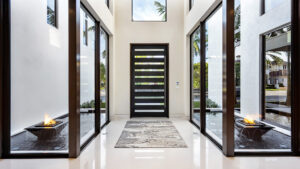
If your front door glass is foggy, cracked, dated or just too dark, glass door inserts in Boynton Beach fix it without replacing the door. We build a piece of decorative glass to fit your exact opening and set it into the door you already own, with that door still hanging on its hinges. Most jobs are finished in one visit, usually an hour or two. Nothing gets torn out, nothing gets repainted, and your house is never left standing open.
The most common call we take here starts almost word for word the same way. “There’s moisture inside the glass and I can’t wipe it off.” A close second: “The door’s fine, I just can’t stand the oval anymore.” Both of those are the same job, and neither one is a reason to buy a new door.
Call (352) 862-4122 and tell us what you’re seeing.
Five Signs Your Door Glass Is Done
Door glass gives out in ways you can recognize from the driveway. If you can point at one of these, the glass is your problem and the door isn’t.
- Haze or moisture inside the glass. The seal between the two panes has failed and humid air is getting into a space that was supposed to stay dry. No amount of cleaning touches it, because the film is on surfaces you can’t reach.
- A pattern that ages the whole house. The brass beveled oval was on nearly every door built around here for a solid fifteen years. It’s sound, it works, and it looks exactly as old as it is.
- A crack, chip or star break. A stone from the mower, a slammed door, a hot afternoon on a west-facing entry. Once the pane is compromised the piece is finished, and if there was a seal, it’s going too.
- A foyer that needs a lamp at noon. Older Boynton homes were built with tiny door glass or none at all, which leaves the entry darker than any other room. A bigger opening changes that in an afternoon.
- Clear glass that shows the whole entry from the street. Usually somebody chose clear for the brightness and regretted it. Frosted or textured glass gives back the light without the view.
Those first two account for most of what we replace in Boynton. Both are pure glass jobs.
What We Put in Its Place
A glass door insert, also called a door lite or doorglass, is a finished panel of glass held in its own two-piece frame. One half goes on the outside face of your door and the other on the inside, and they clamp together through the opening. That’s why the door never comes off its hinges and why the frame around it is never touched.
Sizes are described by how much of the door they cover. A half lite covers roughly the top half and keeps the bottom solid, which is the most private of the three. A 3/4 lite starts just above the handle and runs near the top, and it’s the standard on most Boynton doors from the nineties onward. A full lite runs nearly the whole height for the most daylight. There are narrow sizes for sidelites and short wide ones for the transom above the door.
The decorative surface sits sealed between two clear panes, so the texture and detail are protected. Nothing collects grime in the grooves and nothing needs brushing out. Two flat faces to wipe and that’s it.
Most exterior doors will take a glass insert. What we won’t do is promise anything about your specific door over the phone, because the honest answer depends on how it’s built and how much solid material is left around the opening. That’s what the free estimate is for. We look at the actual door, measure it, and tell you plainly what it can take.
Glass Door Inserts in Boynton Beach: Picking a Look
The catalog is big, but nearly everything sorts into a handful of families, and once you know them the choice gets a lot easier.
- Beveled and decorative glass door inserts. Clear glass with beveled edges, usually mixed with textured panels. Plenty of light, a moderate amount of privacy, and the safest choice on a traditional Boynton front.
- Frosted and privacy glass door inserts. Etched surfaces that scatter light instead of blocking it. You get nearly all the daylight and none of the view.
- Textured glass door inserts. Rain, reed, flemish, glue-chip and granite patterns used on their own for something quieter, or as the private field inside a decorative design.
- Wrought iron glass door inserts. Iron scrollwork sealed between the panes. The boldest thing we install and a natural on the Mediterranean-style homes all over the middle of town.
- Coastal and tropical patterns. Palm, sea grass, waves and shells. These read as genuinely Florida rather than generic, and they suit the homes closer to the water.
- Clear glass. The right answer when a courtyard or a deep covered porch is already screening the entry for you.
Then there’s the metal framing around the glass, which decides more than people expect. Black, bronze, satin nickel and brass all change how the same pattern reads from the street. Black is the current favorite and the most forgiving. Bronze is warmer and sits well against a tile roof. Brass looks great when it’s fresh, which is worth saying, because dull, blotchy brass is the reason so many perfectly good doors look tired.
Match it to your door handle and your porch lights, not to your roof or your shutters. Those are too far away for your eye to connect them.
One more thing worth deciding early: how much pattern you actually want. A busy design looks wonderful in a showroom and can feel like a lot on a modest front. A simpler pattern in the right finish almost always ages better, and it’s the choice people are still happy with ten years on.
Have a look through the catalog, then call (352) 862-4122 and we’ll narrow it down with you.
Foggy Glass Between the Panes
Fog inside the glass means the seal has failed. It’s the most common front door glass failure in South Florida, and it’s worth understanding, because there’s a whole cottage industry selling homeowners a fix that doesn’t last.
Door glass is usually two panes with a sealed space between them. Inside the spacer around the edge is a drying material whose only job is to keep that space dry. The seal is the whole product. When it holds, the glass stays clear for decades. When it lets go, outside air moves in and out of that space every time the door heats up and cools down, and it carries humidity with it.
South Florida is a hard place for that seal and a front door is a hard spot within it. The air is humid nearly year round, so there’s plenty of moisture to carry in. A sun-exposed door swings through a big temperature range every single day, and each swing works the sealant a little more. Sunlight breaks it down over time as well. Once the drying material is saturated, and it saturates much faster here than in a dry climate, the moisture has nowhere to go but onto the glass.
The way it progresses is consistent. First you see fog only in the morning, or only on hot afternoons, and it clears. Then it stops clearing. Then you start seeing permanent streaking where water has evaporated and left minerals behind.
That last stage is why defogging services don’t hold up. Even if someone drills the glass, dries it and reseals it, it isn’t a sealed unit anymore, the drying material is spent, and the etching already on the glass is permanent. In this climate the fog usually comes back. You’ve also generally spent money twice.
Replacing the piece is the real fix, and in a door it’s simple. The failed glass comes out and a new custom piece goes into the same opening, on the same hinges, in the same visit. Most people take the opportunity to change the pattern and the finish while they’re at it, since the labor is identical either way.
If your sidelites are the same age as your door glass, expect them to be near the end too. Pieces installed together tend to fail within a few years of each other, and handling them at once saves a second trip. One easy test: condensation on the room side of the glass on a humid morning is normal and wipes away. Condensation you can’t reach from either side is a failed seal. If you can’t wipe it off, call (352) 862-4122.
What Glass Fixes, and What It Doesn’t
Not every front door complaint is a glass complaint. Here’s the honest sort, so you know which one you’ve got before you call anybody.
Fogged glass. Glass fixes it, completely. This is far and away the most common issue on doors between fifteen and thirty years old around here.
A dated oval or sunburst with brass around it. Glass fixes it, and it’s the biggest visual return in our catalog. Nothing about how the door works changes at all.
A dark entry. Glass fixes it, and it’s often the most dramatic thing you can do to a house. Older Boynton homes in particular were built with almost no glass at the front door, and a larger opening changes the inside more than the outside.
Too much visibility into the house. Glass fixes it. Moving toward a frosted or heavily textured pattern gives you back the privacy without costing you daylight.
A sun-bleached or chalky door finish. Glass doesn’t fix it. A west or south-facing door here takes a beating and every kind of exterior finish fades and loses its gloss eventually. That’s a painting job. We’ll tell you honestly that new glass in a badly chalked door helps less than you’d hope, and that the finish should come first.
Corroded hardware and rusty hinges. Glass doesn’t fix it, and it’s mostly a salt air issue closer to the water. Worth handling alongside a glass change though, because fresh metal next to a green, pitted handle looks worse than either one on its own.
A door that sticks in August and swings free in February. Glass doesn’t fix it. Some doors and frames take on moisture through the wet season and let it go again in the dry months. That’s a door and frame issue, and changing the glass won’t change the way it closes.
Rust or staining coming through at the bottom. Glass doesn’t fix it, and it’s worth flagging early. Corrosion starts down at the bottom and works its way up when water sits at the threshold, and how far it’s gone affects what a door can carry. That’s exactly the kind of thing we look at on a free estimate rather than guess at from a photo.
The pattern there is worth noticing. Anything wrong with the glass is solvable in an afternoon without touching the door. Anything wrong with the door itself is a different trade. We’d rather tell you which one you have than sell you the wrong job.
Privacy and Light at the Same Time
You can have both. Frosted and textured glass scatters light rather than stopping it, so a panel nobody can see through still fills the entry with daylight.
Patterns run from completely clear to lightly textured to fully private. Most front doors land in the middle. Shallow setbacks and busy streets push you toward the private end. Cabana and pool bath doors go all the way there, and they want tempered safety glass, since it’s a wet area with bare feet moving through.
The thing people miss is that privacy works with the light. A pattern that hides everything at noon gives up more at night, with your foyer lit and the street dark. If your porch light stays on in the evening, step up one level. It costs nothing to decide now.
Garage Doors, Cabana Doors and Every Other Exterior Opening
We put glass in exterior doors generally, not just entry doors. Garage doors, cabana and pool bath doors, side and service entries, French and patio doors. Same trade, and usually the same visit.
Garage doors. Boynton leans heavily on the front-facing two-car garage. On the older homes around Golfview Harbour and the streets off Old Boynton Road, the lots are modest and the garage sits right at the front plane of the house, which means it often covers more of what you see than the entry, the windows and the walkway put together. Most of those doors are flat, unglazed, and painted the same color as the wall.
Garage door glass inserts are the cheapest way to make that surface look deliberate. A row of glass across one section is the usual layout, and which section changes everything. Up top you get the carriage house look most elevations here are already reaching for. One section lower suits the low, long shape of an older ranch. Running the same pattern family and the same metal finish as your front door is what ties a split front together, and it’s especially effective on the houses where a dated oval sits next to a blank white garage door.
Privacy is worth a thought out there too, since a garage panel is right at eye height for anyone on the sidewalk. Glue-chip, rain and frosted patterns bring daylight into the bay without showing off what’s stored in it. In the villa communities the bays are often single-car or cart width, which just means a shorter row and a smaller piece of glass.
Cabana and pool bath doors. Screened pools are everywhere here, and the door from the deck into the pool bath is the one opening where privacy is the entire specification. Cabana door glass belongs at the private end of the range and it should be tempered safety glass. Heavy frosted and deeply textured patterns are the usual answer, and if we’re already at the house for your entry, the cabana door gets done the same afternoon.
Side, service and patio doors. The service door out to the side yard, the kitchen door onto the patio, French doors onto the screen enclosure. All of them take glass on the same terms as the front door.
Most exterior doors are workable. Which of yours are, and what each one can carry, is what the free estimate settles. Call (352) 862-4122 and tell us how many openings you’d like looked at.
Impact Glass and Hurricane Season in Boynton Beach
Impact glass door inserts are available and they’re built for the wind and flying debris we get down here. The glass is laminated, meaning a tough layer is bonded between the panes, so when something strikes it the glass cracks and holds together instead of leaving the opening.
Boynton Beach is in Palm Beach County. The requirements here aren’t quite as strict as Miami-Dade and Broward, but storm protection still matters, and what’s actually required depends on where exactly you are. We’ll talk that through with your address rather than quoting a countywide figure that may not apply to your street.
Now the part that gets fudged in a lot of South Florida advertising. Impact ratings cover the whole door as a unit, meaning the glass, the frame and the door together. Putting an impact insert into a door you already own does not turn that door into a rated hurricane door. We check what your specific door can take before recommending one, and we tell you straight when the answer is no.
Not every pattern comes in an impact version either, and the choices thin out as the opening gets larger. Something available as impact glass at half lite size may only exist as standard glass at full lite. We’ll tell you which of the patterns you like are genuinely available the way you want them, rather than letting you pick from photographs and sorting it out later.
Impact glass can help on your insurance, but carriers generally want every opening in the home protected before it counts. Ask your agent before you make it the main reason you’re doing this. We won’t quote you a percentage, because nobody honestly can.
Hurricane season runs June 1 through November 30, and that shapes when this is easy to schedule. Spring is the calm stretch. The phone lights up the moment a storm gets a name, and that’s exactly when lead times stretch. If impact glass is on your list this year, call (352) 862-4122 well before June.
Keeping Your Door vs. Buying a New One
Most Boynton front doors that look bad are structurally fine. The door is sound, the frame is square, the weatherstripping seals and the deadbolt throws. What’s aged is the glass and the metal around it. Replacing the whole door to fix a pane is a bigger project than the problem calls for.
| Glass door insert | New front door | |
|---|---|---|
| Your existing door | Kept, glass swaps out | Removed and discarded |
| Frame, threshold, hardware, keys | All unchanged | New hardware, likely a re-key |
| Paint, stucco and trim | Nothing to repair | Painting and patching |
| Time on site | One visit, an hour or two | Most of a day or more |
There’s an approval angle too, since a lot of Boynton housing sits inside HOA communities. A board looking at “same door, same color, new glass in the existing opening” has a much shorter conversation than a board looking at a whole new front door. We’ll supply the pattern images, the finish name and the product information your packet needs.
We don’t publish prices, because every opening and every piece of glass is different. What moves the number is how big the opening is, impact or standard glass, how detailed the pattern is, and whether the sidelites go in at the same time. Doing the sidelites together costs less than a return trip, and it’s the only way to be sure everything matches.
What to Expect on Install Day
Our process is four steps, and only one of them happens at your house.
- We talk it through. Your door, the style of the house, and how you want to balance light against privacy. If you have an architectural review committee, we’ll work out what they’ll want to see.
- We measure and build. Your actual opening, not a catalog size, so the finished door looks like it came that way from the factory.
- We install. The door stays on its hinges. We mask off the area, cut and frame the opening in place, set and seal the glass, then fit the inside half of the frame. No trim comes off, nothing gets repainted, and the house is never left open.
- We hand it over. We check the swing, the latch and the seal, look at the finished door with you from both sides, and leave you with cleaning instructions.
Same-day installation is normal in Boynton Beach. No day off, no moving furniture, no arranging for the dog to be somewhere else.
Where We Install Glass Door Inserts in Boynton Beach
We work all over Boynton, and what we find behind the address tends to follow the age of the neighborhood.
In the older parts of town, places like Leisureville and Golfview Harbour, the doors are usually solid or have a small original piece of glass, and the complaint is darkness. A bigger opening with a mid-range pattern is the fix, and those doors get a closer look before we cut, because decades of built-up paint and any corrosion down at the bottom change what a door can carry.
Through the communities along Congress Avenue and Old Boynton Road you’re mostly looking at the beveled oval with brass around it, very often with a failed seal behind it. Getting off the brass and into a current pattern is the single biggest improvement available on that kind of house.
Out west in the newer neighborhoods the doors are tall and smooth with plain glass and sidelites, so the job is adding some pattern and privacy to a blank front and getting the sidelites to agree with the door.
East of Federal Highway, out toward the Boynton Harbor Marina, the variable is salt air rather than age. Salt speeds up corrosion on the metal around the glass, on hardware and on hinges, which is why we steer coastal homes toward darker finishes that hide early wear far better than polished brass. Cabana bath doors are common on that side of town too.
We serve the cities around us as well: glass door inserts in Delray Beach, glass door inserts in Lake Worth Beach, glass door inserts in Greenacres, and glass door inserts in West Palm Beach.
Frequently Asked Questions
Why is my door glass foggy between the panes?
The seal between the two panes has failed, so humid outside air now moves into a space that was meant to stay dry every time the door heats up and cools down. The drying material inside the edge eventually gives out and moisture settles on the glass. Our humidity and daily heat swings speed that up considerably.
Can foggy door glass be fixed?
Not permanently. Defogging services drill and dry the glass, but it isn’t a sealed unit anymore, the drying material is spent, and any streaking already etched into the glass stays there. In this climate the fog usually returns. Replacing the piece is the real answer, and in a door that’s a same-visit job.
How long does installation take?
Most Boynton Beach installs are done in one visit, usually an hour or two. Same-day is normal. Your door stays on its hinges the whole time, so there’s no stretch where the house is open, and you don’t need to take the day off or move anything out of the entry.
Do you have to remove the door?
No. The door stays hung for the entire installation. We cut and frame the opening right there, set and seal the glass, and fit the inside half of the frame last. No trim comes off, nothing gets repainted, and your home is never left open to the outside at any point in the job.
Are glass door inserts energy efficient?
They can be. Florida’s a cooling climate, so what matters is keeping heat out. Low-E glass in a sealed double pane cuts down the heat coming through and helps keep your floors and furniture from fading. West-facing entries feel the difference most, since they take the hot afternoon sun straight on.
Can you put glass inserts in a garage door?
We do it all the time. On Boynton’s front-facing two-car garages that panel is often the biggest blank surface on the house, and a row of glass across one section changes the whole look. We’ll check the sections and talk through where the row should sit on a free estimate.
How do you measure for a door glass insert?
We measure your actual opening on site rather than working from a catalog size. For existing glass that means the visible dimensions plus the frame footprint and the thickness of the door. For a new opening in a solid door, we also confirm how much solid material will be left around it.
When is the best time of year to install impact door glass in Florida?
Spring, before hurricane season opens on June 1. The season runs through November 30, and demand jumps the moment a storm has a name on it, which is exactly when lead times get long. Booking in the quiet months means a shorter wait and a schedule that works around you.
Let’s Get Your Door Glass Replaced in One Visit
Fogged glass, a dated oval, a cracked pane, a blank garage door, or an entry that’s been dark for twenty years. All of it is fixable in an afternoon, in the doors you already own. No new door, no new frame, no repainting, no new keys. You keep the door that works and replace the part that stopped working, which is almost always just the glass and the metal around it.
Call Glass Insert Guys of South Florida at (352) 862-4122, or use the quote form to the right. Tell us your neighborhood, roughly how old the door is, what you’re seeing, and whether the garage door should be part of the conversation. A photo helps us narrow it down, and the free estimate confirms what each of your doors can take before anything gets ordered.

